Graceful Time, Graceful Prayer

A Meditation on Keeping a Holy Lent – delivered at St. Julian’s Episcopal Church this Ash Wednesday.  

Sometimes, prayer is like an inside joke between you and God. An inside joke between lovers – A pillow talk intimacy – A full disclosure of full-er grace. Jesus doesn’t ask us to dress for success in order to please others, but to please him. “Why are you spending all your time trying to impress this group or that group,” he might ask? “Why are you defending the indefensible? When you give, when you pray, when you fast give all of it, your whole lot and life of it to me. Loose yourself in me,” says Jesus.[1]

The Season of Lent is a time to re-order one’s life; a time to think where one’s priorities might lay. J. Neil Alexander once wrote, “I used to believe that the important thing was what I believed about God. I have discovered that the really important thing is what God believes about me. I used to believe that the purpose of being a Christian was to learn to live a good and righteous life. I now believe that I am good and righteous, not of my own doing but as a gift of grace by faith in Jesus Christ. I used to believe that if I said my prayers and lived an obedient life, when I died I would inherit eternal life. Now I believe that eternal life begins at the [Baptismal] font and goes on forever. My experience of God has shifted from fear to love, from conditional to unconditional, from judgment to mercy. I used to believe that being a Christian was about me…I’ve discovered…that being a Christian is about God. That’s grace.”[2]

Grace. Maybe that’s at the heart of our inside joke between the two lovers – A history of giving and receiving grace in one another so that grace might be extended out and about to others. May Lent this year be for us graceful – further learning how to give it, how to take it. Remember, don’t flaunt it. Instead, let it be an inside joke between you and The Divine.

[1]           Matthew 6:1-6, 16-21

[2]           J. Neil Alexander, This Far by Grace, A Cowley Publication Book, Lanham: 2003, 6.

Christian Morality Remembers Love

~Sermon on Matthew 5:21-37 preached on the Sixth Sunday after the Epiphany.

God is always calling us to deeper ways of being and presence with Him. We “keep the commandments of God” when we “walk in love as Christ loved us”. This love does not take sides; instead, the two or more sides are either joined together or cast away revealing only Christ. In Matthew’s Gospel, Jesus was inviting his listeners to stop hearing the Holy Scriptures as ends in themselves. He was instead inviting all to experience Scripture as a new beginning – a new beginning to draw nearer to God’s purpose, plan, and will which in turn draws us closer to one another.[1]

I believe God calls us to these deeper ways of being and presence through the act of remembering. Remember when you were slaves in Egypt. Remember, you are dust and to dust you shall return. Remember me when you come into your kingdom. Remember I am with you, always. The act of remembering does not necessarily have to look back. Instead, remembering can be something we are reminded of here in the present. My spiritual director says that most persons who come to her for guidance and spiritual direction are suffering from one underlining thing: They have forgotten that God loves them. Her task then becomes helping persons through their spiritual amnesia, and to recover what memory they may have lost remembering that they are indeed, loved.

Within St. Matthew’s time, a righteous life was seen as one who obeyed and lived into Holy Torah. Following God’s law was considered a discipline and practice in righteous remembering. Last week’s Gospel ended with Jesus saying, “For I tell you, unless your righteousness exceeds that of the scribes and Pharisees, you will never enter the kingdom of heaven.” We pick up how righteousness is viewed in the eyes of Jesus when he teaches his first morality course to us today. His ethical topics include such things as anger, adultery, divorce, and taking oaths. When Jesus tackles these topics, he does not interpret them in crude legalism. Instead, one is considered living righteously into the law when they remember the unity of God. For example, Marcia Y. Riggs makes this observation about Jesus’ attitude toward anger. I quote her at length,

The verses on anger offer us an interpretation that enlarges the frame for understanding the prohibition against murder. Jesus enlarges the prohibition by pointing to ways to which the anger of revenge or punishment that can lead to murder is also evident in the course of living. When you judge and insult a brother or sister in the community, as well as when you are in a legal conflict (both ways in which anger surfaces), you have an opportunity to rectify these situations by seeking the other person out so as to apologize (in the former case) or by making amends outside the legal process (in the latter case). In both cases the objective is clear: to restore relationships through acts of reconciliation. Clearly Jesus is not rescinding the prohibition against murder, but he does place murder on a continuum of outcomes related to anger. Furthermore, Jesus is recognizing that humans do get angry; rather than prohibiting anger, he teaches that it can be transformed by living as a peacemaker (cf. 5:9), initiating acts that manifest the reign of God in our midst[2].

Christians are able to practice the act of reconciliation each time we participate in the passing of The Peace during Holy Communion. Fr. Patrick Mallow says this about The Peace, “The Peace is more than a casual hello but it is not an act of personal affection. It is a gesture of mutual acceptance and forgiveness rooted in a shared humanity and the bonds forged by baptism. The Peace expresses and instills a confidence that equality in Christ (and the equality of all people before God) is rooted in something far more basic than whether people personally know one another.”[3] Again, this gets back to remembering – remembering that we are loved by God and can express this love through peace and reconciliation.

The other issues St. Matthew’s Jesus takes up are adultery, divorce, and oaths. With all of these (including anger), Jesus is not only reminding his listeners on what the righteous life entails, he is also revealing the righteousness of God through remembering God’s intention, will, and purpose within the lives of human beings. St. Augustine taught that God is immutable; in other words, God is unchanging, but God’s creation is mutable. It changes. God does not intend for anger to manifest into abuse, slander, or murder, but mutable humans forget this and make both conscious and unconscious choices to let anger get away from us. God does not intend for adultery and divorce to be a way of life, but humans forget their love and unity found in Christ. God does not intend for oaths to be made, but humans forget to let our Yes be Yes, and our No, No.

So, how can we tell what the will of God is? Are we too bold to ask such a thing? The will of God which points us to the righteous life remembers Christ crucified, died, and resurrected. Christ crucified, died, and resurrected points us all to God’s ultimate love, mercy, and forgiveness. When we remember this, we are free to love, free to show mercy, and free to forgive. When we remember the will of God, we are righteous. When we remember God’s intentions, our presence points to The Good, The Truth, and The Beautiful. This is Good News. This is the Gospel. The Gospel of Jesus Christ is to remind us (and the world) we are loved.

God is always calling us to deeper ways of being and presence with Him. We “keep the commandments of God” when we “walk in love as Christ loved us”. This love does not take sides; instead, the two or more sides are either joined together or cast away revealing only Christ. In Matthew’s Gospel, Jesus was inviting his listeners to stop hearing the Holy Scriptures as ends in themselves. He was instead inviting all to experience Scripture as a new beginning – a new beginning to draw nearer to God’s purpose, plan, and will which in turn draws us closer to one another.[4] We are loved. This week, this day, this moment, try and remember that.

[1]                 Left Behind and Loving It: http://leftbehindandlovingit.blogspot.com/

[2]                 Marcia Riggs, Feasting on the Word, Year A, Vol. 1, David Bartlett and Barbara Brown Taylor, Ed., Westminster John Knox Press, Louisville: 2010, pg. 356-7.

[3]           Patrick Mallow, Celebrating the Eucharist: A Practical Ceremonial Guide for Clergy and Other Liturgical Ministers, Church Publishing: New York, 2007, p. 111-12.

[4]                 Left Behind and Loving It: http://leftbehindandlovingit.blogspot.com/

Christian Leadership

Sermon from 5th Sunday after the Epiphany focusing on Matt. 5:13-20 & Isa. 58:1-12

When I was in high school my Dad got a promotion that required us to move. Even though the place where we settled was only about 40 minutes away, the culture of moving from suburbia to rural was shocking. At my old middle and high schools, I was only involved in a few extra-curricular activities (band and soccer). At the new rural school and with a class size of less than 50, I could do pretty much whatever I wanted. Through my three years at Harmony HS, I was involved in band, drama, choir, basketball, track, and Beta Club. I seemed to be friends with just about everybody, and was at least respected by those who didn’t necessarily want to hang out with me. My wife, Ann, always jokes that she so would not have dated me in HS because of my Brady-Bunch-like interests but I say, “To each his own.”

Maybe it was because of all the activities I was involved in, maybe it was because my Dad was now a training manager for the company he worked for, or maybe it was a little of both; nevertheless, he got me interested in thinking about leadership. Dad had about a 35-minute commute to work, and on many of those driving days he would listen to leadership books on tape. At the time, Steven Covey’s book, The 7 Habits of Highly Effective People was popular, as well as anything by Tony Robbins, and the old-time Texas transplant, Zig Ziglar. Dad got me hooked on these leaders’ thought processes, and challenged me not to ever be a follower in life, but to instead, lead.

Nowadays I am still drawn to leadership books and seminars, but have narrowed down the pile somewhat. Out of seminary, I took at two-year leadership course the diocese offers for new priests that focused on what’s called, adaptive leadership. While in seminary, I studied family-systems theory through the lens of Edwin Friedman, and here lately I’ve been interested in thinking about Jesus Christ as a leader with the help of Henri Nouwen. It’s this latter author I want to speak on today because Nouwen has helped me to totally flip my idea and ideas about Christian leadership – something all baptized Christians are called to live into.

In his book, In the Name of Jesus: Reflections on Christian Leadership, Henri Nouwen makes this argument, “[Jesus] asks us to move from a concern for relevance to a life of prayer, from worries about popularity to communal and mutual ministry, and from a leadership built on power to a leadership in which we critically discern where God is leading us and our people.”

Let’s look at the first point, “[Jesus] asks us to move from a concern for relevance to a life of prayer…” Before my family made that move from suburbia to rural Texas, the Baptist Church, the Church where I was raised and that introduced me to Jesus Christ, was concerned with relevance and being relevant. In the 90’s I heard my youth ministers tell me not to listen to certain types of music because similar styles of rock or heavy metal or rap music could be found with a Christian message. For many years, I heeded their advice, went to Christian concerts, bought Christian CDs, and did what I was told because I respected my leaders. This was also the time in the church where suits were ditched for skinny jeans and t-shirts, and a minister wasn’t cool if he didn’t have a goat-tee, tattoo, and crazy stories of redemption. All things considered, and for me, the church was relevant. It made sense to my teenager mind, and I trusted those who were trying to lead me. In hindsight; however, I don’t know if my youth director or even my senior pastor ever taught how to pray. Prayer, and how to pray stays with you, but certain types of music, fashionable clothing, and even a cool story fades with time. While in college, I would ditch all these fads still not knowing how to pray, and take up other things to fill the time – mainly girls, alcohol and parties.

Nouwen makes a compelling argument that the present and future church doesn’t have to be relevant to survive; instead, its leaders must always have a solid life of prayer, and be able to teach that to Christians of all ages. My friend and colleague, Fr. Greg Tallant, has often said that there is something to be said about boring old church. There’s something to say about people still gathering together, praying for one another, and creating fellowship through the person of Jesus Christ. I tend to agree. The Church and her rituals have been around for millennia, and through them we are taught to pray and to remember one another in thought, word, and deed. The question, “How do I pray?” can always be on the minds of Christians, and living into its answer is a journey out of relevance into that of relationship.

Let’s turn to Nouwen’s second point, “[Jesus] asks us to move from…worries about popularity to communal and mutual ministry…” Here, he is specifically calling out ministers whose ministry revolves only around them and their celebrity. Through other leadership resources I have learned that good leaders make people believe in them, but great leaders make others believe in themselves. Put in Christian terms – instead of top down ministry, why not operate from the bottom up? What are the gifts and talents of everyone? If you could choose one gift or talent you possess and could teach it to someone else, what would it be? Well, whatever it is could be your ministry, or at the very least, plugging into a group or organization that is already living similar gifts out.

Churches grow, and ministries expand not out of a great priest or bishop. Instead, they grow and expand when resources are pulled together based on need – yes – but also based on gifts and talents. Again, what is it you can do that is also teachable? Great! That is your ministry. The future of the church will not revolve around its paid clergy so much so as it will revolve around all the baptized living out their mission and ministries in the world.

Nouwen’s final point, “[Jesus] asks us to move…from a leadership built on power to a leadership in which we critically discern where God is leading us and our people.” My Dad was half-way correct when he gave me the advice not to be a follower in life, but instead, lead. A Christian leader, I would now counter, is perfectly comfortable being led because they are being led closer to God through a life of prayer and community, which in turn, allows them to not only lead people, but to have the humbleness to be led by Christ and others. Nouwen writes, “It seems easier to be God than to love God, easier to control people than to love people, easier to own life than to love life…The long painful history of the church is the history of people ever and again tempted to choose power over love, control over the cross, being a leader over being led. Those who resisted this temptation to the end and thereby give us hope are the true saints.”

These three attributes of a Christian leader: not worrying about relevance, not worrying about popularity, and learning how to be led by God (I believe) can best be lived out in a small parish like ours through its ministries, through its liturgies, and through its fellowship. In today’s Gospel lesson Jesus says that we are the salt of the earth and the light of the world. When we forget this, we loose our taste and get lost in the dark. The Prophet Isaiah gave specifics around this. He said God wasn’t interested in your piety. Stop being relevant to your religion, and reveal your relationship with God to your neighbor (Isa. 58). How do you do this? “Share your bread with the hungry, bring the poor into your house, and to cover the naked.” Just last week, the prophet Micah preached, “act justly, love mercy, walk humbly with your God.” Being just doesn’t seem to be relevant these days, loving mercy is certainly not popular, and walking humbly with God isn’t mainstream leadership material. So what are Christian leaders supposed to do? I like what Isaiah said, “Shout out, do not hold back! Lift up your voice like a trumpet! We are most prophetic, we are light and salt, we are leaders when we pray, when we form relationships, when we fellowship, when we are led by God. I believe the Church is best when it’s boring…when it’s doing exactly what its mission is. When we worship joyfully, when we serve compassionately, when we grow spiritually, the church is simply doing what the church does. It may not be relevant to the world, but it is relevant to God. It may not be popular, but that’s okay…Jesus said The Son of Man has no place to lay his head. It may not raise up leaders the way the world defines leadership. That’s okay, Jesus taught us to pray saying God, Lead us not into temptation: The temptation to be relevant, to be popular, to be powerful. Instead, let us empty ourselves, let us serve others, and let us focus on Christ.

Search your heart today. Are you trying to be relevant or popular? Are you trying to lead, win an argument, or be on the right side of history? Instead, check yourself. What does your prayer life look like? What is a gift or talent you have but haven’t shared? Is God trying to lead you somewhere? If so, have you discerned where? The Collect from this morning says this, “Set us free, O God, from the bondage of our sins, and give us the liberty of that abundant life which you have made known to us in your Son our Savior Jesus Christ.” We are free when we love. We let go when we know someone is there to catch us, and we experience abundant life when we are led. May we live into this with a discerning heart this week, and find peace within us so that we can offer the peace of Christ to a merciless world. AMEN.
Progress is Starting Over

Sometimes progress is simply sticking with it. Rolling up sleeves, dirt on the hands day in and day out breeds grit and determination met with much grace, hope, and love. The former things point us to character, the latter – virtues. These are what you’ll find every Thursday evening and Saturday mornings at Starting Over, a court appointed supervised visitation ministry, held on the campus of Saint Julian’s Episcopal Church.

For close to 20 years, Starting Over has provided a space where separated families can put aside their differences, come together and show a sense of normalcy with their children by playing games, talking, and simply allowing kids to be kids. Volunteers serve as supervisors and watchful guardians of the visiting children, and then report back to DFCS (The Georgia Division of Family and Children Services) whether or not the visitation was successful.

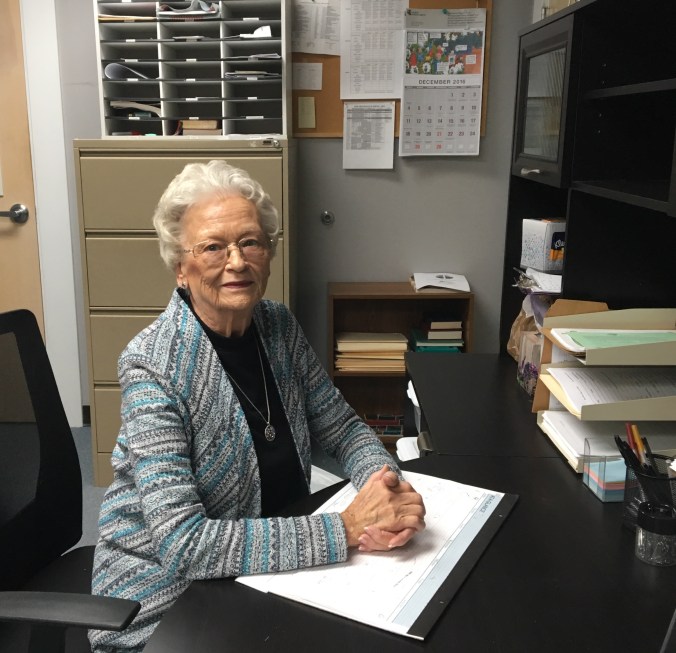
The backbone of Starting Over, her matriarch, gatekeeper, and heart is Diane Campbell. Diane might describe herself as hard on the outside, but soft inside – much like an M&M candy. Her hardness comes from the heartbreaking stories of children who have been neglected, abused, and forgotten by families and an apathetic society. Her softness comes from her faith where she remembers Jesus’ words to, “let the children come” (Matt. 19:14). Diane understands the facts. She knows the high rates of teenage pregnancy, and thousands of children caught up in the foster system. She recognizes the stress put on social workers, and why the turnover rate seems to increase year after year. She has moments of compassion fatigue, but she also experiences divine love. Like a mother hen gathers her chicks under her wings, Diane is willing – willing to protect them at all costs (Matt. 23:37). Willing to stand up for what is right. Willing when no one else seems so.

It’s been said that raising a child takes a village. How will history judge the village we call Douglasville? If the system is broken, are we willing to come together and repair it? If a family is fragmented, are we brave enough to serve them? If a social worker is overwhelmed, can we rise up in support? These are not questions of stagnation or apathy; rather, they are questions of progress, and questions of holy curiosity, neighborly love, and gifted grace.

Let us not be distracted by many things (Luke 10:41); instead, let us collectively roll up our sleeves and do the hard work of reconciliation day in and day out. For Diane and her army of volunteers, it is children whom they serve. Who or what are you called to serve? Spend a lifetime living into this question, and progress along life’s road, in your heart, and in your soul will be revealed.

~This article will be featured in the Douglas County Sentinel’s Profiles in Progress section in Sunday, January 22nd’s paper. To learn more or donate to Starting Over’s ministry, please find St. Julian’s address here.#LoveLikeJesusEDA diane-campbell

Dust Your Self Off and Try Again

Last year I suggested to the parish I serve not to create New Year’s resolutions. The gentle challenge had a practical application: Most New Year’s resolutions end in failure, and what follows is personal guilt and blame. Instead, I recommended taking on New Year’s experiments. Experiments, by definition, welcome failure in order to learn something new. There is no guilt involved – only an adjustment or tweak here and there to run the experiment again. The message got through to some, and throughout this year I have had several parishioners share with me their various experiments, and what seemed to work or not.

As I ponder 2016, and look towards 2017 I will be running some new experiments of my own as well as continuing some of the experiments I ran this past year. I’d like to share a few of these with you, and challenge you to come up with your own.

My first experiment I will be continuing into 2017 is to read and listen to the “other side”.

Last year during the season of Lent and Easter, I challenged myself to read books on conservative thought, as well as to bend my ear towards many of my politically conservative friends. The immediate result of studying the history of conservative thought in England and America was that my political leanings drifted from the left into the middle. For me, this is a good place to be since my vocation lends its ear to those who wept during the presidential election (Democrats) and those who rejoiced (Republicans). Although the president-elect does not necessarily fit into the traditional mold of American party politics, through my reading and conversation, I have a better grasp of where his proposed policies or political appointments stand on the spectrum of the conservative/liberal spectrum.

Where I will continue this experiment on into the new year is to get my news from newspapers and in-depth books – not social media, or television. For 2017, I have subscribed to two local papers, The Douglas County Sentinel and the Atlanta-Journal Constitution. I have also subscribed to The New York Times and The Washington Post. These newspapers not only hold to the code of sound journalism, but by subscribing to them, I am also supporting this important medium of news reporting. Thus far, my reading and understanding of the issues that are important to my community and our world have been enlightening.

My second continuation of 2016 experiments is to read fiction and poetry.

Reading is a life-long love of mine, so this will probably never change; but as I get older I am realizing more and more the power of novels, poetry, and short-stories on the imagination, the soul, and how they can inform me in totally different ways than a newspaper ever will. I read 28 books this last year. I’m challenging myself to do 30 for 2017.

My final experiment is to continue to practice my vocation of the priesthood.

This means praying the Daily Office everyday, reading and studying the Bible weekly, writing sermons that challenge, loving the parishioners I serve, as well as serving ‘the other,’ ‘the stranger,’ and ‘the neighbor’ outside the walls of the parish. I feel all of this begins at home. I practice my calling to the priesthood by practicing my vocation to marriage and parenting. This translates into all walks of my life; so to be a good father, husband, and son means being a good priest and visa-versa. I thank God for my family (and extended parish family) everyday. This gratitude is something I want God to remind me of more and more in the coming years.

These are simple, yet doable experiments, and please take notice that none of my experiments have anything to do with fear or anxiety. These two vices played roughly in 2016, but will be sidelined in 2017 as far as I’m concerned. I have no time for them.

In closing, these are experiments – not resolutions. I won’t necessarily complete them in the way I may imagine them now, but that’s okay. I will dust myself off and try again. So, here’s to 2017 – another year to dust your self off and try again – And try again we must.

Balancing the Bigger Picture of Christmas

And the Word became flesh and lived among us. ~John 1:14 

“Take a step back,” my Dad called out to me. “You’re standing too close. Take a step back, and you can see it better.” We were visiting the Art Institute of Chicago, and what IT turned out to be was Georges Seurat’s famous painting, A Sunday Afternoon on the Island of La Grande Jatte. The painting’s iconic because up close one realizes the whole piece was painted with little dots. Artists call this technique pointillism, and at the time I wasn’t so interested in the bigger picture. I had studied this painting in school, and I wanted to experience the dots myself, so my face was as close to the painting as I could possibly get without making the security guard standing to my left suspiciously nervous. I eventually backed away, marveled at the size and scope of the painting, but for some reason, I kept focusing in on those silly dots.

The dramatic lead up to Jesus’ birth is found in the Gospels of Luke and Matthew. Within Luke’s Gospel, we have the angel, Gabriel, visiting Mary and revealing she is with child; while in Matthew, we take a step back from the pregnancy and begin with the genealogy of Jesus. (Mark’s Gospel has no birth narrative. It begins with the baptism of Jesus as an adult). It is only with the Gospel according to John where the largest step away from the nativity scene happens. From its angle, the bigger picture, the idea, the point, and the revelation all stand revealed. John steps all the way back to the genesis where we discover that God, through the person of Jesus Christ, has always been and always will be. (What a picture John paints for those who believe). And what is this belief? The belief is what theologians call the Incarnation, what the prophets of old named as Emmanuel, and why worshippers celebrate Christmas. God took on flesh and walked among us. This is the Christmas miracle. This is the new beginning.

If we contemplate this theological space of new beginnings, the world opens up its mystery to us. We begin to experience within us and all around us those creative aspects found in God’s creation. A sense of awe, wonder, and imagination pricks the senses as we surrender ourselves to truth, beauty, and love. John’s Gospel reveals that God’s master plan has always been incarnation; and now, with the living breathing person of Jesus his mark on the painting is now complete. It is God’s most important point. The one holding the whole picture together; and yet I find myself torn between wanting to focus my whole attention on the dot that is Jesus Christ while at the same time feel compelled to take a step back and see the bigger picture. In that delicate space of contemplation is where the greatest mystery opens itself up to me. It is in the tension of the manger where I also find the cross of Christ. It is in the details of Jesus’ life where God is fully revealed to me. In this Christmas season, I know that I am called to the one who will feed the hungry, heal the sick, and forgive our sins. I know that I am called to love like Jesus for in doing so I realize the same love God finds within me is found in the other, the stranger, and the neighbor. These are crucial and oftentimes overwhelmingly crushing details where I feel compelled to take a step back and remember the larger picture. I wonder if that is the point of Jesus? That is, to remind us how to love, while at the same time pointing us in the direction of Love itself? I suppose it is a balancing act for us. A discernment. A knowing and an un-knowing all at the same time.

This Christmas, marvel at the point on the picture. Take notice that the security guard standing to your left is supposed to be a bit nervous. After all, institutions and those in charge do get nervous when we all start taking our art, our religion, and our Lord Jesus Christ seriously. Get close to the dots and at the same time don’t forget the picture as a whole. Each dot is important. Dare I say we can find our own dot within the picture, for in doing so, we discover God within us. How humbling it is to know incarnation was part of the plan the whole time. How sobering it is to know we are all part of the bigger story – a story within a story – the art and painting of God.

A Cry in the Wilderness

It’s been said John the Baptizer had one foot in the past and another in the future. The foot held in the past was not one of pure nostalgia, but of integrity – integrity that realized the work of God in the lives of God’s people in spite of themselves; and, for that foot in the future, John (like the prophet Isaiah) worked as an artist that envisioned a new age, a new city, a new dawning. This New Way was made explicit in the very location of John’s preaching. Matt. 3:1 reads, “In those days, John the Baptist appeared in the wilderness.” All you studious Biblical scholars out there can remind us that the Hebrew people appeared in the wilderness, and it was there that God revealed God’s Holy law, or Torah. It was also in the wilderness that the people ebbed and flowed in and out of their faith, and were either judged or blessed by God according to their thoughts, words, and deeds. It was in this wilderness and through its struggles that the Israelites grew in holiness with the help of God and Torah. The people would later be led out of the wilderness into the Promised Land where the great City of Jerusalem would be built, and eventually God’s Holy Temple with it. This new city would be central in the lives of the Jewish people.

Matthew’s Gospel takes this beautiful history of The Exodus, and does a clever role reversal. Instead of the people going into the central city of Jerusalem; instead of the people making sacrifice and confession with the Temple priests; instead of the clergy staying in Jerusalem – Matthew has them all going out into the wilderness. Going out and into the margins where a strange looking artistic, itinerate preacher was preaching repentance and baptism. Like moths to a flame, the people came. Why – Maybe because preaching repentance worked – Maybe because baptism worked? Dare I say both still work today?

It’s in this literary and liturgical structure of repentance and baptism that Matthew introduces a Third Way. This third way wasn’t an act on their part. It wasn’t even a belief. Instead, the third way, the new center, the new city is found in a Person. “A shoot shall come out from the stump of Jesse” (you’ll remember Jesse was King David’s father), “and a branch shall grow out of his roots [and] the spirit of the Lord shall rest on him” (Isa. 11:1). In Matthew’s Gospel, the family tree of David gets expanded in the person of Jesus Christ, and this tree is firmly planted not in a centralized location, city, or state; but on the outskirts of town, on the margins of society where if you come to see it, it does not discriminate whom seeks comfort among its shade. “Come to me all who are weary and burdened, and I will give thee rest” (Matt. 11:28). It is underneath the shade of this tree, and later the shadow of its cross where helplessness found hope, and meaninglessness discovered its significance.

One of Bishop Rob Wright’s favorite lines when he is among clergy is that, “all the answers are not found at 2744 Peachtree Road.” (This is the address of the Bishop’s offices and the Cathedral of St. Philip). Instead, he empowers us all to seek out answers and innovations from one another. There’s a great collective wisdom within the room that is our diocese, and a lot of that wisdom is OtP (Outside the Perimeter). The Church is best when it worships joyfully, serves compassionately, and grows spiritually; when it loves God, self and neighbor (in that order), and understands that going out to the margins and marginalized of society does not necessarily mean going into the big city. There is wisdom in the wilderness. In fact, one of the reasons I personally love this Gospel passage is because of Matthew’s portrayal of John the Baptist. Matthew, I believe, pegs John as an artist. He’s a very talented artist in performance (i.e. preaching repentance) and with his props (i.e. water). And what do good artists do? They draw people to them and to their work; but John was not only a good artist, he was a great artist. And what do great artists do? They point beyond themselves, and even beyond the art, itself. The people from the center of the city go out to John believing they are there to see and experience him and his ministry; but when they show up John tells them, “it’s not about me.” Great art never is; instead, it is a vehicle and vessel that is used for transcendence. That’s some creativity.

As a kid I would go and visit my grandparents quite often. At the time, my Memom and Granddad were attending a small Missionary Baptist church on a farm-to-market-road in East Texas. Getting to this tiny church, where most of the cemetery was made up of my relatives, we would pass by other small churches. Since it was a very rural part of the state with no neighborhoods, I wondered why there simply wasn’t one church? Why did it have to be 3 or 4? It seemed to me that if people pulled their resources together, they could come up with a centralized church that saw one another as family and supported each other in the good times and the bad. (I guess even as a kid, I felt a strong pull to a more centralized church – how very Episcopalian of me). Serving in Douglasville has brought back some of this childlike curiosity. There seems to be a church on every corner in this county. Why aren’t we talking with one another? Or maybe we have, but we haven’t been invited to the party in a while?

Are churches guilty of self-preservation so much so that coming together, and sharing our assets and resources not a priority? I often times wonder what a town like Douglasville would look like if all the churches got together and tackled one major community problem each year? What if we all got together and started asking artistic questions that pointed beyond ourselves, and our egos? I have a feeling that important conversations would get started if we came together around common causes. Perhaps the teenage pregnancy rate would go down? Perhaps the thousands of kids in the foster care system would find homes? Perhaps no family would go hungry, and no child would be left behind to recycle their family history of poverty?

John the Baptizer was a big burly man who revealed simple truths in an artistic way that made God the center of everything no matter where one resided. Of course God was in Jerusalem, but God was also in the margins. Of course God is at 2744 Peachtree Rd, but He’s also at 5400 Stewart Mill Road along with the hundreds of other churches found within this county who have more similarities than differences…who still believe (collectively, and like John) that repentance and baptism work. I do honor the differences in theology, and in worship, and in the reading of scripture (this is good art), but don’t you think God gets tired of the same old arguments denominations and ‘nondenominations’ have with one another? The one thing that brings us all together is not found in a theology, in a city, or in a song, but in a Person – the person of Jesus Christ who Christians boldly claim is God. And if we’re all reading the same book together, I believe God tells us to love. And God tells us to give. And God tells us to serve, and the person of Jesus Christ lived and continues to live out these virtues of the Spirit within all of us.

Saint Julian’s Episcopal Church is a little church on the margins surrounded by other denominations. We’re also a little church that’s part of the bigger Episcopal Branch of the Jesus Movement. Let’s continue to balance love of self and focus on our parish community, its building and its people alongside the people out there. Let’s get curious with the greater community. I can’t do it on my own. You can’t do it on your own. We need one another. We need to better define our neighbors. We need to repent of apathy, and we need to remind the world it still needs Jesus. This was John’s message. This has always been the Church’s message, and this is society’s message as well as its cry for help out in the wilderness.

Happy Advent

The Advent Season

What is Advent, and what does this transitional season represent to Christians? How do the traditions, liturgy, and prayers of the Church allow hearts to be transformed during this time of year? Why does the Church caution Christians not to jump into Christmas after Thanksgiving Day? Let us live into these questions as we remember the counter-cultural expression of this beautiful season called Advent.

Traditionally, the Season of Advent represents the preparation and coming of Our Lord Jesus Christ. In fact, the word, Advent, literally means, Coming, and its readings, liturgy, and music all point to Christ coming into the world with three different expressions: We remember Christ coming into the world at Christmas, within our hearts, and the expectation of Christ coming again at the end of time. The mood of the season fills the soul with great mystery, tension, and anticipation. For four weeks, hymns, prayers, and Bible readings grace the liturgy with metaphor, simile, and prophetic signs. Words such as restoration, prophecy, and repentance will help to enhance this tension filled season. There will be reminders to keep awake – to not get distracted by all the noises around us – and to remember and reflect on the eternal. Advent invites all to melt into its spell where senses develop an awareness of light and darkness, evergreen trees and deciduous ones, mountains and valleys, the future and The Now.

The Advent Wreath

We can thank our 17th century German sisters and brothers for the development of the Advent wreath (Bishop J. Neil Alexander, Celebrating Liturgical Time, 44-45). What started out as a domestic devotion was later adapted (and adopted) by the Church as its own countdown clock (Ibid.). That is why there are four candles in Advent wreaths representing the four weeks of this season. The Advent wreath, like the Tenebrae services of Lent, reveals humanity’s fascination with the lengthening and shorting of days (Ibid). Advent occurs during the Winter Solstice where the earth’s Northern hemisphere tilts from its sun making the nights longer and the days shorter. Advent is a transitional season anticipating Christmas where the son, or the light of the world will be revealed making His light more abundant on earth, and within the hearts of mankind.

Advent wreaths are made up of evergreen tree branches. Evergreen trees are symbolic of eternity because they do not change with the seasons. They are firm, steadfast, and constant year round. When Christians put Advent wreaths on their doors or in their homes, they symbolically point to both the eternal and the now – or better – the Eternal Now.

The Readings of Advent

In the readings from Advent I, we symbolically remember what it is like to experience the daytime (light) and the nighttime (darkness). Paul says, in his Letter to the Romans, “salvation is nearer to us now than when we became believers; the night is far gone, the day is near. Let us then lay aside the works of darkness and put on the armor of light; let us live honorably as in the day” (Romans 13:11). Jesus echoes this when he teaches, “Keep awake therefore, for you do not know on what day your Lord is coming. But understand this: if the owner of the house had known in what part of the night the thief was coming, he would have stayed awake and would not have let his house be broken into. Therefore you also must be ready, for the Son of Man is coming at an unexpected hour” (Matt. 24:42).

The Experience of Advent

You know those vacation or holiday nights when you’re visiting a friend, relative, or loved one you haven’t seen in a long time, and you stay up all night talking and catching up? You might have a good drink in your hand, and a fire going on in the fireplace. Table lamps are lit instead of overhead lights. There’s some soft music on in the background that mixes with your moments of conversation yet leaves room enough for those still small moments of nonanxious silences. “You say it best when you say nothing at all” yet when a word is spoken your beloved, perhaps, says it better than you because they know you…you have a history together, and being in the moment is more important than being right. It’s with this revealing picture that I envision Paul and Jesus’ words. Even though it’s dark outside, even though the world is a big fat mess, and when I’m out in it (half the time) I’m distracted by competing voices, for this moment and with my friend, I’m living in the light of Now with God, with my loved one, with the music, and I’m soaking up every simple yet complex thing because for that moment I’m awake. I think that that’s a different type of anticipation, a different type of tension where one can honestly and in the moment stomp on fear and anxiety because there is no fear and anxiety. Something deeper is going on. These are Now moments of anticipation where everything has changed; yet, everything has stayed the same. In Advent, we say that Christ has come into our lives…that the light of the world has come into our hearts yet again. The world is still the same; yet the world is vastly different. And that’s as much as I can describe (with words) the experience of Advent. Paul did it one way. Jesus another. Me another; and you have your own as well.

An Invitation

This Advent, contemplate the mystery of God in your life. Look back on where God seemed to have been holding you, or carrying you, or even dragging you along life’s path. Observe the novel that is your life. Observe the song, or the hymn that is your life intricately wrapped up in the life of the Divine. We only have four weeks, so let’s use our time wisely, anticipating where we know we will be distracted, and don’t be (with God’s help). It’s only four weeks. Instead, focus and occupy your mind, your body, your soul on God, self, and neighbor. Who is God? Who am I? Who is my neighbor? These questions provide an appropriate meditation for a few weeks that could start out for 4, and turn into a lifetime of living into those questions: Who is God? Who am I? Who is my neighbor? Advent, by it’s very nature of light and dark, mystery and metaphor, comings and goings will enhance these questions, question your answers, and help you find that friend you have (perhaps) always been searching for, and longing to stay up the whole night chatting and catching up. As today’s Collect reminds us to pray: “Almighty God, give us grace to cast away the works of darkness, and put on the armor of light, now in the time of this mortal life… [and] in the life immortal.” Happy Advent!

A Reflection on Forgiveness

Read Luke 23:33-43. After reading this passage, reflect on Jesus’ words,”Father, forgive them; for they do not know what they are doing.” After reflecting on Jesus’ words, then reflect on the thief’s words, “Jesus, remember me when you come into your kingdom.”

After the above meditation, ask yourself the below questions. Spend some time with God as you live into these questions. Afterwards, you are invited to write down your own thoughts, feelings, and reflections about forgiveness.

When we ask for forgiveness, are we not really asking God, our friend, our family member, the one wronged, to remember us…to remember who we truly are in spite of ourselves at moments of weakness?

Can forgiveness be both an act in itself, as well as a state of being?

When we actively forgive, does it free the forgiver up more than the one receiving it, or is there an equal exchange of forgiveness?

Did Jesus open himself up to being able to forgive the unforgivable, or does he simply swim in the stuff?

Why do we often times put conditions on forgiveness, but God does not?

Is it okay to forgive, and not forget?

Why is it easier to see and judge the wrongs of others; yet so hard to turn the mirror in our direction?

When the mirror is turned in our direction, why even then, is it still hard to acknowledge our faults? Is this pride? Is it spiritual blindness? Is it then necessary to practice how to forgive ourselves?

If I practice forgiveness, will it make me less judgmental?

Is it healthy to fake it before I make it?

There are so many questions. Jesus, will you remember me when you come into your kingdom?


Identity Politics in The Body of Christ

Today at the 110th Annual Council meeting of The Episcopal Church of Atlanta in Middle and North Georgia, Resolution 16-7 passed after a two-hour floor exercise that included countless amendments, amendments to amendments, debate, anxiety, and opinions.

Let me go ahead and show my cards on matters such as these, and say I oppose the Church involving itself in what is sometimes labeled, ‘identity politics.’ The Episcopal Church’s slogan is, “All are welcome,” and I have come to the simple conclusion that all means all when it comes to welcoming the stranger, the neighbor, the enemy, and the other. Where I felt a ping of sadness was that the Church felt it necessary to specifically name and label groups of people instead of letting “all” stand as is. Let me give you some background and context for my sadness.

I believe the Church’s genesis point of where we meet one another in Christ has shifted. It has shifted from experiencing each individual person as divine mystery, created in the image of God to a group identity politic. The original identity politics held the Church as the Body of Christ, with Christ being the head (Col. 1:18). The telos of Christ’s Church, then, was to allow the Body to grow into the likeness of Christ (2 Cor. 3:18). Put another way, we used to believe in the content of one’s character instead of the color of one’s skin, one’s sexual orientation, one’s disability, one’s rights, etc. I sometimes wonder… What if The Episcopal Church got out of the rights business and back into the relationship business?

I understand the context of why Resolution 16-7 was written. The United States is still recovering from a tumultuous election, and half the country is in a panic. The proposal wanted everyone to know that the Episcopal Church welcomes all no matter what, but with acknowledged  skepticism, I wondered if the resolution would truly get outside the echo chamber that is The Episcopal Church.

One of the problems with allowing so much energy and resources to filter into identity politics is that groups, by definition are exclusive; whereas, the Church of Jesus Christ is inclusive. There is a certain groupthink that takes place, and anyone outside the groups’ normative ways of thinking is dismissed as a racist, homophobe, bigot, etc. Why would the Church support a construct such as this?

I desire the Church to get back to the basics of Holy Scripture, Tradition, and Reason as a catalyst for furthering our relationship with God, self, neighbor, creation, other, and enemy. At its best, the Church lives into this day in and day out; however, I am growing weary with The Episcopal Church and its strange social justice bedfellows. There are other options, and ways to live, move and have our being in this important work of reconciliation, but I believe the starting point is not with rights. It’s with relationship.

Now that I showed my own biases, and in conclusion, let me simply say the hard work I experienced in the room today was beautiful and inspiring. The way Bishop Robert C. Wright held the tension, yet allowed and made room for the Spirit to move was truly impressive. All the Christians who stood up, spoke from the heart, and truly listened to one another. I believed we experienced one another as the Body of Christ. I believed compassion and spiritual health was strengthened. I believed all were truly welcomed, and why not? Although I disagree with the results of this resolution, I am forever grateful for the journey into deeper relationship one with another, and for that I say, “Thanks be to God.”