Present Yourself to the Lord – A Meditation on Candlemas

**The following was featured on the blog, Modern Metanoia in January, and preached at a Candlemas Service at St. Julian’s Episcopal Church on Feb. 2, 2018.**

There’s a house on my block that sold weeks ago. No one has moved in. It sits empty; and there are still Christmas lights hanging from the roof. Its purgatory-like presence both intrigues and annoys. Annoys because the house and its yard are untidy. Intrigues because today is the Feast of the Presentation of Our Lord.

Let me explain:  Today marks the 40th day after Christmas, and with this feast the Church closes out the “Incarnation cycle.” In other words, it’s time to put away those Christmas decorations. We’re two weeks away from Lent…Shouldn’t we be tidying up the yards of our hearts, climbing a ladder to the roofs of our souls tearing down those Christmas lights? “Not so fast,” says this Feast Day. In fact, some Christian traditions hide away the light bulbs while the candles come out. For this reason, The Feast of the Presentation of Our Lord is sometimes referred to as Candlemas. It’s the day when the candles used in worship services will be blessed. It’s also a reminder that the long winter’s nights are still around, yet the light of Christ eternally radiates the darkness.

Luke 2:22-40 gives us three presentations to consider on this feast day. The holy family presented sacrifices of thanksgiving in accordance with the law of Moses (“a pair of turtledoves or two young pigeons”). They also presented their newborn son, Jesus, who “suddenly comes to his temple;” thus fulfilling an ancient messianic prophesy found in Malachi 3:1. The third presentation is that of Simeon and Anna, two pious and patient Jews, who waited their whole lives to present themselves to the Messiah.

Luke’s story also captures the tensions and realities found in new things. A new child was born as the Messiah, yet old thoughts and formularies about what this meant had to pass away. Mary, like any mother, was proud of her new son, yet she learned “a sword [would] pierce [her] heart” when new revelations about her child would be exposed (Luke 2:35). For each beginning, there is an ending; and the transitions in between are often messy and confusing.

As we transition out of Christmas and Epiphany into the season of Lent, may Candlemas be a day to honor what has come before, and to ready ourselves as to what may lay ahead. If the lights are still on your roof, know that the house of your heart does not stand empty, but is filled with God’s “wisdom and favor” (Luke 2:40). If the Christmas decorations are down at your house, take out a candle, light it, and present yourself to the Lord in prayer as Christ presents himself to you in illumination.

Below, please find the prayer that will be said in Episcopal churches and homes today. I offer it to you in thanksgiving for your ministry to Christ. Use the prayer as you light a candle, then find a word or phrase that sticks out to you, and meditate on its meaning. As for me (and my soon-to-be neighbor) who knows? I may go over to their sold, yet unkempt house, plug in those Christmas lights one last time, praying and contemplating something similar.

Almighty and everliving God, we humbly pray that, as your only-begotten Son was this day presented in the temple, so we may be presented to you with pure and clean hearts by Jesus Christ our Lord; who lives and reigns with you and the Holy Spirit, one God, now and for ever. Amen. (BCP, 239)


The Sound of Silence

~Now there was a great wind, so strong that it was splitting mountains and breaking rocks in pieces before the Lord, but the Lord was not in the wind; and after the wind an earthquake, but the Lord was not in the earthquake; and after the earthquake a fire, but the Lord was not in the fire; and after the fire a sound of sheer silence.~1Kings 19:11-13

A Responsorial Psalm 

The wind is my breath, says the LORD.
It is partially me, but not all of me.
The earth quakes at my presence
Because I AM its Creat-or.
The earth is my crea-tion.

Fire is a technology of creation,
And like the earth and wind it is not me.
It is my crea-tion.

Earth, wind, and fire.
Even though all three are my creations;
And they are good, I AM ultimate Good.
All will pass away, but I WILL remain
Like the sheer silence that is there,
But isn’t there, so I AM.

Man is tempted by creation
And the technologies grounded in creation.
The temptation is to worship them like Baal
And to try and possess them as if they are man’s.
Creation cannot be possessed; it is gift.

Can you capture the wind?
Can your feet remain steady while the earth quakes?
Are you not burned by fire?

Man is also tempted by the gods
Even though the masks of old have
Long been removed.
Choose now whom you will serve.
Make steady your mind;
Shield your face, yet keep your eyes open.

Put good things (but not The Good)
Out of your mind. Exit your silos and
Leave your caves. You fall in love with
Your own voice that echoes off their walls.
Follow me to the edge and listen. Listen.

There is truth in the world. But I AM ultimate Truth.
You will find me when you find Love;
You will recognize me when you experience Beauty;
You will fall to your knees when you discover
The sheer sound of silence. I AM in it all; yet beyond it all.

There are no words;
There are no technologies;
There are no-things that can capture me.
Listen for me. Listen to me. Listen with me.

And when you listen know that I will not
Ask little from you, but much.
I desire your life not as a slave but as liberation.
My creatures and creation are partial.
I AM absolute. Do not divide me up but
Seek my unity found in my life-giving Love.

Do you not remember my Son, the Beloved, and
How he walked in Love? By his very gait he
Welcomed the earth as his own.
With his calm stride he brought ease to the tempest, and
In his touch brought fire to the dis-eased.
He did not worship earth,
Wind, and fire. He did not bow down
To hunger, eros, or power. He revealed
These aberrations as idols and
Illumined the heart readying it for repentance.

If you cannot remember my Son,
then at least my Spirit?
My Holy Spirit continues to move in His Bride
–The Church – and yet her Body has become divided.
She has left the opening of the cave
Where she once listened for my voice and has
Retreated back into its chamber.

Why do you withhold my Truth from the world?
Why do you admire the ringing of your own voices?
Have you forgotten sheer silence?

I have not forgotten you. I AM with you.
I AM waiting for you. Come back out and
Into the open. I will no longer distract you
With earth, wind, and fire – I never have.
These were gifts as you are gifts to me.
Come back out to me and quiet rest I WILL give.

Noticing the Holy

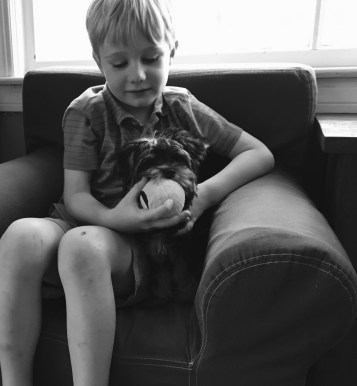
Henry and Brownie
Above: Henry and Brownie

2nd Sunday After Pentecost: Matthew 9:35-10:8

At the end of winter and the beginning of spring, Ann, Henry, and I got a dog and named him Brownie. Brownie is a Morkie, or a cross between a Yorkshire terrier and a Maltese. In other words, he’s super cute. Ann and I have never been dog people, but every time we visited friends with dogs, or came across dogs on evening walks our hearts softened towards them. This softening of the heart combined with Henry telling us he wanted a dog made us finally give in and get our little Brownie. Since Brownie has entered into our lives, I have observed something about our family. We have started to notice more. Perhaps having a dog in one’s life helps us to cultivate a slower pace of life? This slowing down and noticing happens on our evening walks with Brownie, and going for a stroll has helped to cultivate at least four things. Walking a dog helps to cultivate mindfulness, responsibility, beauty, and compassion.

Mindfulness

When we are out and about in our neighborhood, and when the walking pace is slow and steady, I start to notice the smell of the air, the softness of the breeze. Ann may notice a new house for sale, and that Henry has his shoes on the wrong feet – again. Brownie is aware of the grass. He makes no distinction between the tall or the freshly cut even though humans are drawn to the order of a well manicured lawn. Also, voices in conversation sound different outside, and even if we have seen each other all day long, there is something about changing the context that makes conversation fresh, new, and rewarding.

Responsibility

The second thing noticing cultivates is responsibility. Mondays are the neighborhood trash pick-up days. After pickup, many times trash bins are left in the middle of driveways or dangerously close to the road. Lids could be in yards, and left over pieces of paper may be wet, sticking to the sidewalk. Henry has told us that littering is ‘rude’ so he’s drawn to the paper. Ann may go for a lid, and I go for the actual trashcan. We often find ourselves noticing the disorder, and try to order it in our own little way. Who knows, maybe it helps the next walker or jogger going down the sidewalk? Maybe it helps the neighbor?

Beauty and Compassion

Noticing also cultivates beauty and compassion. There’s beauty in slowing one’s pace down that enhances compassion for one’s self and others. Since our family has added Brownie to it, we have met more of our neighbors than ever before. We’re stopped by moms with strollers, jogging dads, and walking couples. We exchange names, talk about local schools, and brag on our children, grandchildren, and animals. There is great beauty in small talk, and being able to notice this has increased my own capacity for compassion.

Matthew 9:35-10:8

Today’s scripture has Jesus walking. He’s walking around first century Palestine preaching and teaching. He’s curing diseases and healing the sick. This is classic Jesus. This is what he does, but looking at the text a little closer, I couldn’t help but notice what he noticed. Listen to the text, “When he saw the crowds, he had compassion for them…” This isn’t an ordinary type of seeing (the crowds), or even looking (at them). Instead, I believe Jesus was noticing them (maybe for the first time). There is a different between seeing and noticing. When we see something, we usually name it, or make a snap judgment about it, and seeing in this way stays at the surface. If I look out and see you, I may register your name and make a quick observation: “That sweater Joe is wearing is red. It looks warms. I’m cold. I wish I had a sweater.”

Noticing is all together something different. Noticing goes below the surface of things where there is an emotional connection that has the potential to lead to compassion. Joe may have that red sweater, and it looks warm to me, but I get to go deeper when I take a moment to remember a conversation we may have had earlier, or know that Joe is in church because he shared with me that he is searching for God in his life again. I am then moved to compassion out of simply going deeper in my noticing.

When we intentionally see others with an eye of empathy, we also start to notice things within us that need attention. For example, when Jesus noticed the crowds, he also noticed that he needed help ministering to them. Maybe he was overwhelmed by the neediness of the crowd. Remember what he said, “The harvest is plentiful, but the laborers are few.” He realized that his preaching, teaching, and healing ministry was not sustainable on his own. He needed helpers, so he called the Twelve and gave them authority, not only to preach and teach, but gave them permission to notice – specifically to notice the harassed and helpless, like sheep without a shepherd. The disciple’s ministry became part of Jesus’ ministry, and Jesus’ ministry was grounded in a holy noticing. Jesus’ instructions to his disciples were to proclaim the Good News: “The Kingdom of heaven has come near.” This proclamation expanded the ministry of Jesus to the people. In other words, not only are the disciples to take up the ministry of noticing, but also the people were invited to notice the kingdom found in Jesus and one another. The people not only were invited to notice this, but also were healed by it. Jesus, as head of this kingdom welcomed the crowds into it through his healing ministry. When one was healed by Jesus in body, mind, or spirit, they became part of this kingdom. They became part of his story, and other people started noticing.

For Us

What have you noticed in your life and in the life of your parish lately? In Lynda Barry’s book, Syllabus: Notes from an Accidental Professor, she shapes an interesting exercise in noticing. She has the one noticing draw a cross. After drawing the cross, and in the upper left hand corner she asks you to write down 5 things that you saw today. In the upper right-hand corner, she asks you to write down 5 things you overheard today. In the bottom right corner, she asks you to complete this sentence “Lately, I’ve learned…” and you write a sentence or two about what you’ve learned. Finally, for the lower left corner, she asks you to doodle or sketch something you saw today. What a great exercise in noticing. What a great exercise in remembering the kingdom of heaven. What a great exercise in cultivating an awareness and compassion for the world around you.

July 1st will be my 3-year anniversary serving alongside you in Christ’s ministry. In order to honor our time together, and to take the time to notice God’s Spirit at work in the world, I want to invite you to 1 of 2 listening sessions. The 1st will take place on Tuesday, July 11th at 7 PM, and the 2nd one on Sunday July 16th after the coffee hour. Please choose 1 of those dates and come to the listening session. I will share with you what I have noticed over my 3 years with you, and where and what I believe God is calling us to pay attention to. I will then stop noticing, and ask you to share your own thoughts as to where you believe we as a parish are being called. In the Winter I sent out a parish-wide survey asking for feedback on topics like Leadership, Stewardship, Fellowship, Discipleship, and Worship. I will report back on some of those findings and these topics will also guide our conversation and time together. In the meantime, if you want to use the above Lynda Barry exercise I just shared with you, and tweak it to fit in with our parish context, please do so. Like Jesus, I hope to foster a church culture that notices a whole host of things – be they virtues or vices that need our attention, love, mercy, and compassion.

Until then, I challenge you to start noticing more because the world is anything but boring, and as you are noticing, take the time to proclaim this good news – the kingdom of heaven has come near.


Graceful Time, Graceful Prayer

A Meditation on Keeping a Holy Lent – delivered at St. Julian’s Episcopal Church this Ash Wednesday.  

Sometimes, prayer is like an inside joke between you and God. An inside joke between lovers – A pillow talk intimacy – A full disclosure of full-er grace. Jesus doesn’t ask us to dress for success in order to please others, but to please him. “Why are you spending all your time trying to impress this group or that group,” he might ask? “Why are you defending the indefensible? When you give, when you pray, when you fast give all of it, your whole lot and life of it to me. Loose yourself in me,” says Jesus.[1]

The Season of Lent is a time to re-order one’s life; a time to think where one’s priorities might lay. J. Neil Alexander once wrote, “I used to believe that the important thing was what I believed about God. I have discovered that the really important thing is what God believes about me. I used to believe that the purpose of being a Christian was to learn to live a good and righteous life. I now believe that I am good and righteous, not of my own doing but as a gift of grace by faith in Jesus Christ. I used to believe that if I said my prayers and lived an obedient life, when I died I would inherit eternal life. Now I believe that eternal life begins at the [Baptismal] font and goes on forever. My experience of God has shifted from fear to love, from conditional to unconditional, from judgment to mercy. I used to believe that being a Christian was about me…I’ve discovered…that being a Christian is about God. That’s grace.”[2]

Grace. Maybe that’s at the heart of our inside joke between the two lovers – A history of giving and receiving grace in one another so that grace might be extended out and about to others. May Lent this year be for us graceful – further learning how to give it, how to take it. Remember, don’t flaunt it. Instead, let it be an inside joke between you and The Divine.

[1]           Matthew 6:1-6, 16-21

[2]           J. Neil Alexander, This Far by Grace, A Cowley Publication Book, Lanham: 2003, 6.

Remembering Baptism

Matthew 3:13-17 – Year A – The Baptism of Our Lord Jesus Christ

“Jesus did not come to change the mind of God about humanity. Jesus came to change the mind of humanity about God.” ~Richard Rohr

 “[T]o understand baptism, we must understand the reality, the physicality, of being human, and what it means to say that God saved us by becoming just like us.” ~Steven D. Driver

Throughout scripture, mainly in the writings of St. Paul, we learn that who we really are and why we are has everything to do with Christ. We live, move, and have our being in Christ. We love and are loved in Christ. We forgive and are forgiven in Christ. It was Jesus – The Christ – who taught these things, and lived out these things in His own ministry. By taking on the mind of Christ, and through imitation of Him, we practice His ministry when we, walk in love as Christ loves us. So it is no surprise that many first century Jews and Gentiles imitated Christ through the two sacraments Jesus instituted: Baptism and Communion. Two sacraments we will remember and renew today. Two sacraments that take meaning out and into the world every time gathered Christians are dismissed to go forth in the name of Christ (BCP, 366).

It’s been said imitation is the first form of flattery, and I would argue that humans have been trying to imitate God ever since the beginning. Our ancestors first imitated God by creating. God, the Book of Genesis reads, created the heavens and the earth [and] the earth was a formless void; yet, God formed something out of this void. Likewise, the first humans formed something out of a void through the act of procreation. It can be argued that the family was one of the first expressions of humans creating, and how mind boggling this must have been for earth’s first mother. First there was nothing – then (for Eve) – there was something. A true miracle; and, like all creation God and mankind use what they have around them to create, and in doing so create a new thing.

John the Baptist was creating a new thing out of a very old thing. Just like the Spirit of God hovered over the waters of creation, John the Baptist would wade into the waters of the Jordan, and invite others to do the same. He intuitively knew that water cleansed, that water washed, that water nourished, and anyone who wanted to participate in this new/old thing were welcomed. By baptizing, John’s intention was to publicly name (right then and there) that this person (or persons) have repented. But then, Jesus wades into the waters. They must have been familiar to Him; after all, if we believe in a Trinitarian God, then Christ was present in the very beginning hovering over the face of the deep dark waters. After Christ swept over this water, then God said, “Let there be light,” and there was light. Similarly, Jesus told John, “Let it be so now,” then, the Gospel reads, John consented, Jesus was baptized, and God (yet again) created a new thing. Going back to the book of Genesis, God said that the newly created light was good. Then Matthew’s Gospel reads, that [God] was well pleased with His Son. God always sees the good in His creation and is well pleased with His creativity. God the Father always loves His Son through the Holy Spirit. God, at all times and at all places is constantly inviting us to participate in His goodness. God saved us by becoming just like us. It was a new thing. It was a good thing. It was a holy thing.

This Epiphany, ask yourself what it means to imitate God, to take on the mind of Christ, to live into the waters of creation. Marvel in the miracle of new life, new birth, and new opportunities to co-create with God. Remember your baptism, renew it with Christ’s Body and Blood, then you will be invited to “go forth in the name of Christ. Thanks be to God.” AMEN.


Dust Your Self Off and Try Again

Last year I suggested to the parish I serve not to create New Year’s resolutions. The gentle challenge had a practical application: Most New Year’s resolutions end in failure, and what follows is personal guilt and blame. Instead, I recommended taking on New Year’s experiments. Experiments, by definition, welcome failure in order to learn something new. There is no guilt involved – only an adjustment or tweak here and there to run the experiment again. The message got through to some, and throughout this year I have had several parishioners share with me their various experiments, and what seemed to work or not.

As I ponder 2016, and look towards 2017 I will be running some new experiments of my own as well as continuing some of the experiments I ran this past year. I’d like to share a few of these with you, and challenge you to come up with your own.

My first experiment I will be continuing into 2017 is to read and listen to the “other side”.

Last year during the season of Lent and Easter, I challenged myself to read books on conservative thought, as well as to bend my ear towards many of my politically conservative friends. The immediate result of studying the history of conservative thought in England and America was that my political leanings drifted from the left into the middle. For me, this is a good place to be since my vocation lends its ear to those who wept during the presidential election (Democrats) and those who rejoiced (Republicans). Although the president-elect does not necessarily fit into the traditional mold of American party politics, through my reading and conversation, I have a better grasp of where his proposed policies or political appointments stand on the spectrum of the conservative/liberal spectrum.

Where I will continue this experiment on into the new year is to get my news from newspapers and in-depth books – not social media, or television. For 2017, I have subscribed to two local papers, The Douglas County Sentinel and the Atlanta-Journal Constitution. I have also subscribed to The New York Times and The Washington Post. These newspapers not only hold to the code of sound journalism, but by subscribing to them, I am also supporting this important medium of news reporting. Thus far, my reading and understanding of the issues that are important to my community and our world have been enlightening.

My second continuation of 2016 experiments is to read fiction and poetry.

Reading is a life-long love of mine, so this will probably never change; but as I get older I am realizing more and more the power of novels, poetry, and short-stories on the imagination, the soul, and how they can inform me in totally different ways than a newspaper ever will. I read 28 books this last year. I’m challenging myself to do 30 for 2017.

My final experiment is to continue to practice my vocation of the priesthood.

This means praying the Daily Office everyday, reading and studying the Bible weekly, writing sermons that challenge, loving the parishioners I serve, as well as serving ‘the other,’ ‘the stranger,’ and ‘the neighbor’ outside the walls of the parish. I feel all of this begins at home. I practice my calling to the priesthood by practicing my vocation to marriage and parenting. This translates into all walks of my life; so to be a good father, husband, and son means being a good priest and visa-versa. I thank God for my family (and extended parish family) everyday. This gratitude is something I want God to remind me of more and more in the coming years.

These are simple, yet doable experiments, and please take notice that none of my experiments have anything to do with fear or anxiety. These two vices played roughly in 2016, but will be sidelined in 2017 as far as I’m concerned. I have no time for them.

In closing, these are experiments – not resolutions. I won’t necessarily complete them in the way I may imagine them now, but that’s okay. I will dust myself off and try again. So, here’s to 2017 – another year to dust your self off and try again – And try again we must.

Happy Advent

The Advent Season

What is Advent, and what does this transitional season represent to Christians? How do the traditions, liturgy, and prayers of the Church allow hearts to be transformed during this time of year? Why does the Church caution Christians not to jump into Christmas after Thanksgiving Day? Let us live into these questions as we remember the counter-cultural expression of this beautiful season called Advent.

Traditionally, the Season of Advent represents the preparation and coming of Our Lord Jesus Christ. In fact, the word, Advent, literally means, Coming, and its readings, liturgy, and music all point to Christ coming into the world with three different expressions: We remember Christ coming into the world at Christmas, within our hearts, and the expectation of Christ coming again at the end of time. The mood of the season fills the soul with great mystery, tension, and anticipation. For four weeks, hymns, prayers, and Bible readings grace the liturgy with metaphor, simile, and prophetic signs. Words such as restoration, prophecy, and repentance will help to enhance this tension filled season. There will be reminders to keep awake – to not get distracted by all the noises around us – and to remember and reflect on the eternal. Advent invites all to melt into its spell where senses develop an awareness of light and darkness, evergreen trees and deciduous ones, mountains and valleys, the future and The Now.

The Advent Wreath

We can thank our 17th century German sisters and brothers for the development of the Advent wreath (Bishop J. Neil Alexander, Celebrating Liturgical Time, 44-45). What started out as a domestic devotion was later adapted (and adopted) by the Church as its own countdown clock (Ibid.). That is why there are four candles in Advent wreaths representing the four weeks of this season. The Advent wreath, like the Tenebrae services of Lent, reveals humanity’s fascination with the lengthening and shorting of days (Ibid). Advent occurs during the Winter Solstice where the earth’s Northern hemisphere tilts from its sun making the nights longer and the days shorter. Advent is a transitional season anticipating Christmas where the son, or the light of the world will be revealed making His light more abundant on earth, and within the hearts of mankind.

Advent wreaths are made up of evergreen tree branches. Evergreen trees are symbolic of eternity because they do not change with the seasons. They are firm, steadfast, and constant year round. When Christians put Advent wreaths on their doors or in their homes, they symbolically point to both the eternal and the now – or better – the Eternal Now.

The Readings of Advent

In the readings from Advent I, we symbolically remember what it is like to experience the daytime (light) and the nighttime (darkness). Paul says, in his Letter to the Romans, “salvation is nearer to us now than when we became believers; the night is far gone, the day is near. Let us then lay aside the works of darkness and put on the armor of light; let us live honorably as in the day” (Romans 13:11). Jesus echoes this when he teaches, “Keep awake therefore, for you do not know on what day your Lord is coming. But understand this: if the owner of the house had known in what part of the night the thief was coming, he would have stayed awake and would not have let his house be broken into. Therefore you also must be ready, for the Son of Man is coming at an unexpected hour” (Matt. 24:42).

The Experience of Advent

You know those vacation or holiday nights when you’re visiting a friend, relative, or loved one you haven’t seen in a long time, and you stay up all night talking and catching up? You might have a good drink in your hand, and a fire going on in the fireplace. Table lamps are lit instead of overhead lights. There’s some soft music on in the background that mixes with your moments of conversation yet leaves room enough for those still small moments of nonanxious silences. “You say it best when you say nothing at all” yet when a word is spoken your beloved, perhaps, says it better than you because they know you…you have a history together, and being in the moment is more important than being right. It’s with this revealing picture that I envision Paul and Jesus’ words. Even though it’s dark outside, even though the world is a big fat mess, and when I’m out in it (half the time) I’m distracted by competing voices, for this moment and with my friend, I’m living in the light of Now with God, with my loved one, with the music, and I’m soaking up every simple yet complex thing because for that moment I’m awake. I think that that’s a different type of anticipation, a different type of tension where one can honestly and in the moment stomp on fear and anxiety because there is no fear and anxiety. Something deeper is going on. These are Now moments of anticipation where everything has changed; yet, everything has stayed the same. In Advent, we say that Christ has come into our lives…that the light of the world has come into our hearts yet again. The world is still the same; yet the world is vastly different. And that’s as much as I can describe (with words) the experience of Advent. Paul did it one way. Jesus another. Me another; and you have your own as well.

An Invitation

This Advent, contemplate the mystery of God in your life. Look back on where God seemed to have been holding you, or carrying you, or even dragging you along life’s path. Observe the novel that is your life. Observe the song, or the hymn that is your life intricately wrapped up in the life of the Divine. We only have four weeks, so let’s use our time wisely, anticipating where we know we will be distracted, and don’t be (with God’s help). It’s only four weeks. Instead, focus and occupy your mind, your body, your soul on God, self, and neighbor. Who is God? Who am I? Who is my neighbor? These questions provide an appropriate meditation for a few weeks that could start out for 4, and turn into a lifetime of living into those questions: Who is God? Who am I? Who is my neighbor? Advent, by it’s very nature of light and dark, mystery and metaphor, comings and goings will enhance these questions, question your answers, and help you find that friend you have (perhaps) always been searching for, and longing to stay up the whole night chatting and catching up. As today’s Collect reminds us to pray: “Almighty God, give us grace to cast away the works of darkness, and put on the armor of light, now in the time of this mortal life… [and] in the life immortal.” Happy Advent!

Growing in the Faith: The Wisdom of Psalm 146

I sometimes wonder who wrote the individual Psalms that make up The Psalter in our Bibles and prayer books? Who were these people? What were their lives like? What compelled them to write down such intimate things? Tradition has the writer of the Psalms as David, but scholars have sense proven that quaint thought wrong. And good riddance, I say. Why give all the credit to just one man? For the light-hearted, or at least the poetically minded, scholars tend to burst our bubbles with objective fact, reason, and natural sensibilities. Existential worlds are turned upside when it is discovered that George Washington didn’t actually chop down a cherry tree, William Shakespeare might not have written all those brilliant plays, or that there’s actually two versions of The Ten Commandments. So, why do I say, good riddance to a child-like faith while still finding nostalgic value in the stories of our world? I say good riddance because I want to integrate my faith: the deep with the shallow, the hope with the despair, my inner soul with the souls of my feet stepping out on faith and tiptoeing into the light.

The writer of Psalm 146 does this for me. I imagine him to be a man who started out with a child-like faith: Praising the Lord, but categorizing praise and holding it captive to just one designated place – quite possibly the Temple. As he grew in his faith, he not only wrote, “Praise the Lord,” but “Praise the Lord, O my soul!” Now we’re talking. He started to integrate praise, thanksgiving, and devotion to places both within and outside himself where God was made known to him…not exclusively in Temple, but quite possibly in a lover’s eyes, or maybe the smile of a stranger, or the warming touch of a friend who had always shone him dignity.

The author’s been around the block a time or two because he warns us, “Don’t put your trust in princes…there’s no help there. Their policies and procedures will die away with them.” Instead, he says, “Why not put your trust in the one who made heaven and earth, the sea, and all that is in them…who keeps faith forever?” This writer’s faith journey is mapped out right before our eyes, and many on the journey tend to stop here. They stop with the awesome awareness that the God they serve, (The God of Jacob for our writer), is the very God who created the cosmos. It’s enough (for some) to look out over nature, see the awesomeness of it…the beauty of it, and to attribute the whole of it to a creator God, and that’s okay. We all have our moments, and those are certainly good and grand moments when we think back on them. But look what happens on this writer’s journey. He doesn’t stop there. His faith continues, and God is not only found in himself; God is not only found in the Temple; God is not only found in nature, but God is found every time justice is served, and every time food is given to the hungry. The Lord (our author says) sets the prisoners free, opens eyes, lifts up, loves, watches over folks, and upholds the outcasts. The Lord is in both the macro and the micro-cosms of our lives, so much so that when we look out over the ocean and feel the presence of God, this same spiritual presence can also be found in human touch, in bread and wine, in musical expression, and in all the nooks and crannies of our lives; as well as in the lives of the stranger, the neighbor, and the other.

For Christians the ultimate faith turned into action came in the form of a person – Jesus Christ, who we call God because his life was lived by doing exactly what the Psalmist says God always does: “executes justice, feeds the hungry, sets prisoners free, opens the eyes of the blind, and upholds the orphan and the widow.” For Jesus, there was no categorizing and cataloging faith. Faith was one movement: Integrating the body with the soul while experiencing the Spirit moving through it all. This too is our calling: To integrate God’s Spirit into every facet of our lives so much so that one prays and praises God without ceasing. Every act is an act in love because we are simply responding to God’s eternal love towards us.

The Psalmist reminds us that there’s always an open invitation to take our faith deeper, to go beyond the beauty. In fact, seeing God in the beautiful things in life is quite easy. It’s when we can see God in the mundane that we really start to experience God in a different way, in an integrated way, in a way that the Psalmist was able to express and invites us to do the same, “Praise the Lord, O my soul.”